Kway AI · Guiyang, China
Molecular design in the browser, and the engineering around it
Software that turns AI-for-science methods into tools people can run: an open molecular design platform, research data systems, lab websites and computing pipelines.
Academic collaboration and commercial purchaseEmail yvquan.li@gmail.comWeChat yvquanli
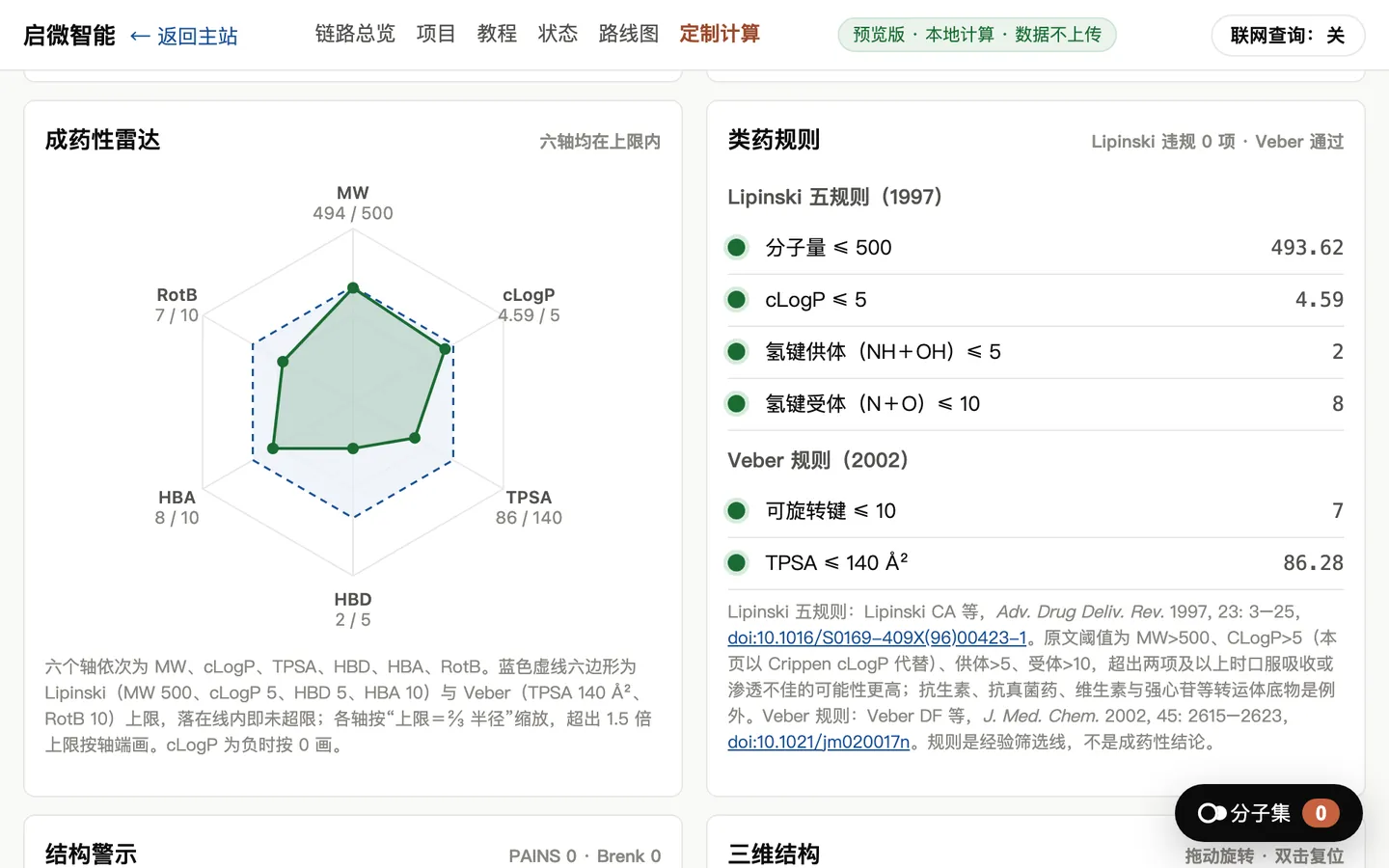
Molecular design platform · In beta
mol.kway.cc: what runs today
Type a name or SMILES. Calculations run in your browser (RDKit compiled to WebAssembly); molecules are not uploaded. Interface in Chinese.
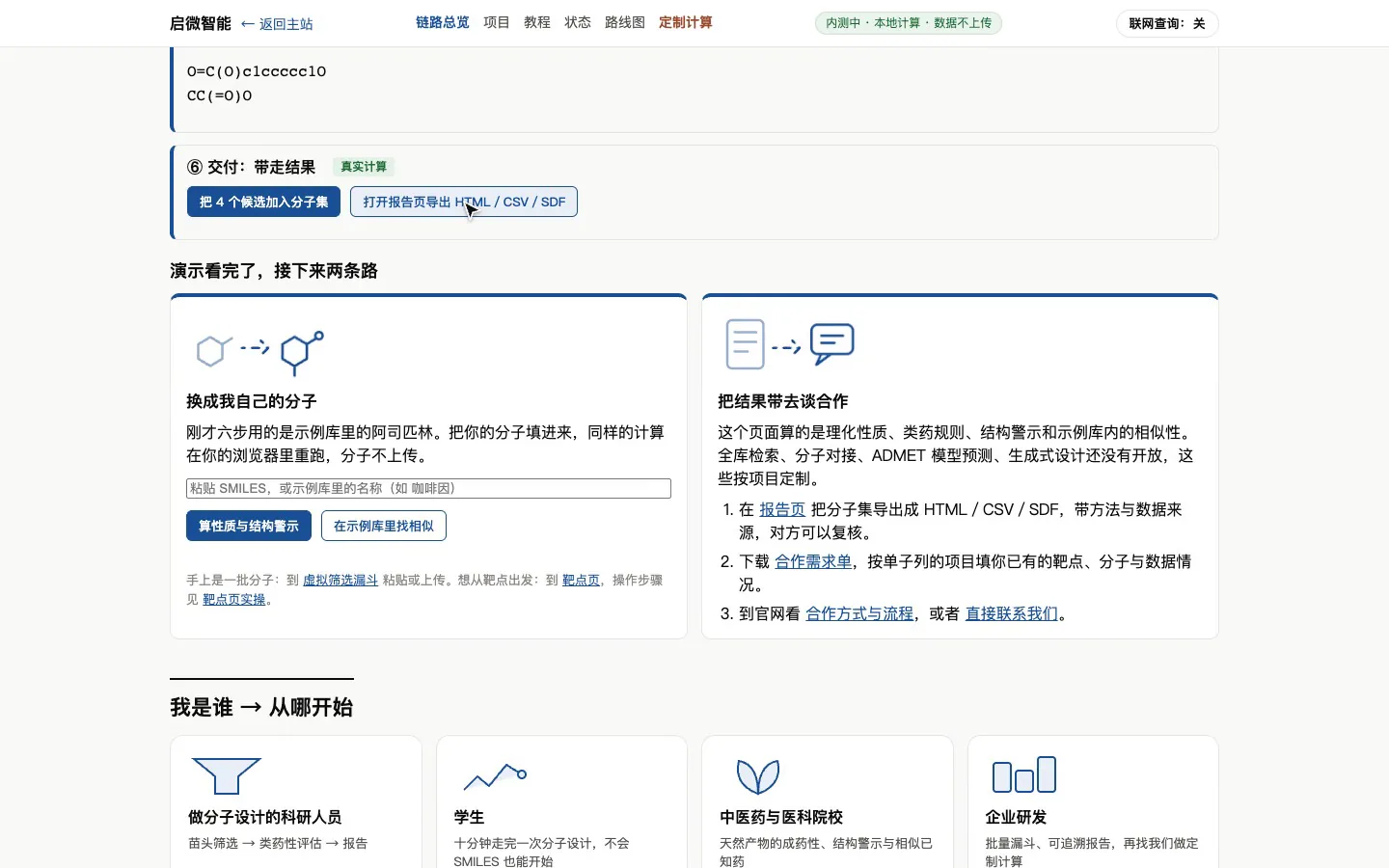
Screen recording / screenshot of the live platform (Chinese interface).
- TargetsIn beta
- Hit findingIn beta
- OptimisationIn beta
- Drug-likenessIn beta
- SynthesisIn beta
- ReportIn beta
- WorkspaceIn beta
- 3D structureIn beta
- Natural productsIn beta
- TutorialIn beta
What each module does
- Targets
- Search UniProt and PDB targets and view structures and ligands in 3D (built-in examples work offline)
- Hit finding
- Similarity search and a multi-step virtual screening funnel, with per-step rejection details and CSV export
- Optimisation
- R-group enumeration, scaffold replacement, matched molecular pairs and SAR tables around a hit
- Drug-likeness
- Physicochemical properties, drug-likeness rules (Lipinski, Veber and others) and structural alerts per molecule
- Synthesis
- Template-based reaction enumeration; retrosynthesis is planned
- Report
- Export one round of results as an archivable report
- Workspace
- Project workspace stored in your own browser, never uploaded
- 3D structure
- Generate a 3D conformer for any molecule in the browser and download .mol / .sdf / .xyz; docking is planned
- Natural products
- Search a curated set of natural products, each with a cited public source
- Tutorial
- Step-by-step tutorial starting from your first molecule
Limits: the 3D page gives one low-energy conformer, not a guaranteed global minimum, and is not for quantitative docking. Server-side docking and generative design are done as projects, not on the open platform.
Three more domain platforms
Natural products and traditional Chinese medicine, crop protection, smart breeding. Chinese interfaces; access differs per platform.
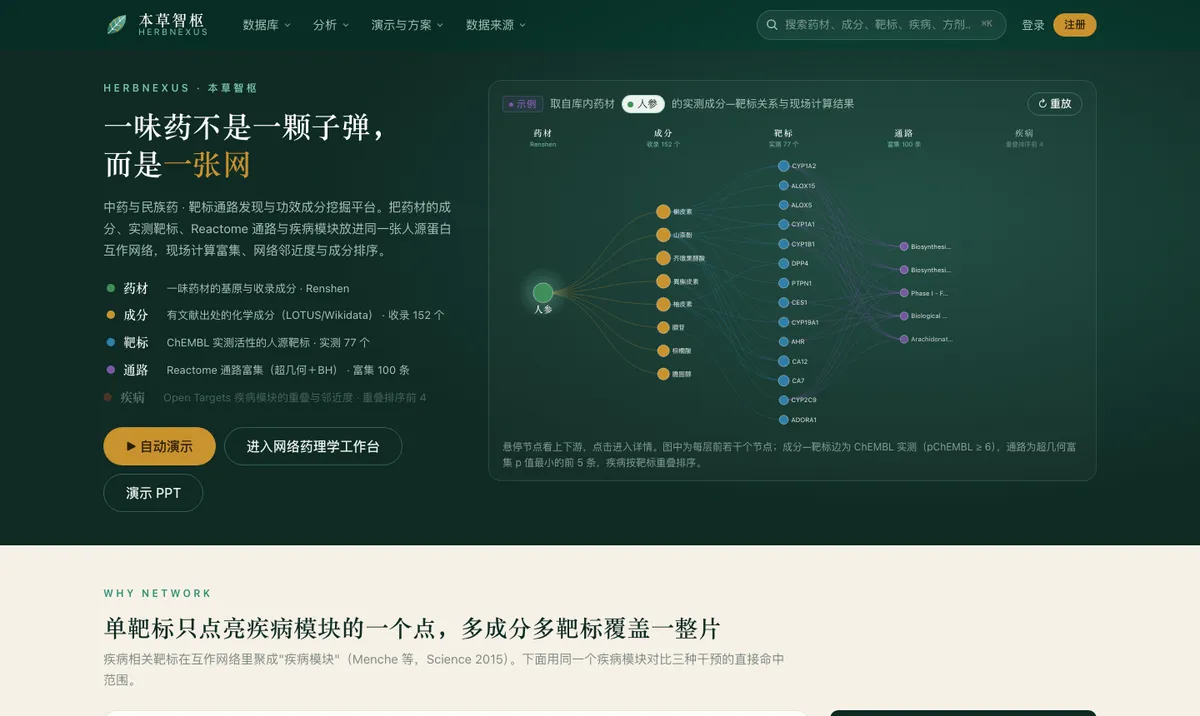 HerbNexus 本草智枢In beta
tcm.kway.cc · Home page public; demo on request
HerbNexus 本草智枢In beta
tcm.kway.cc · Home page public; demo on request
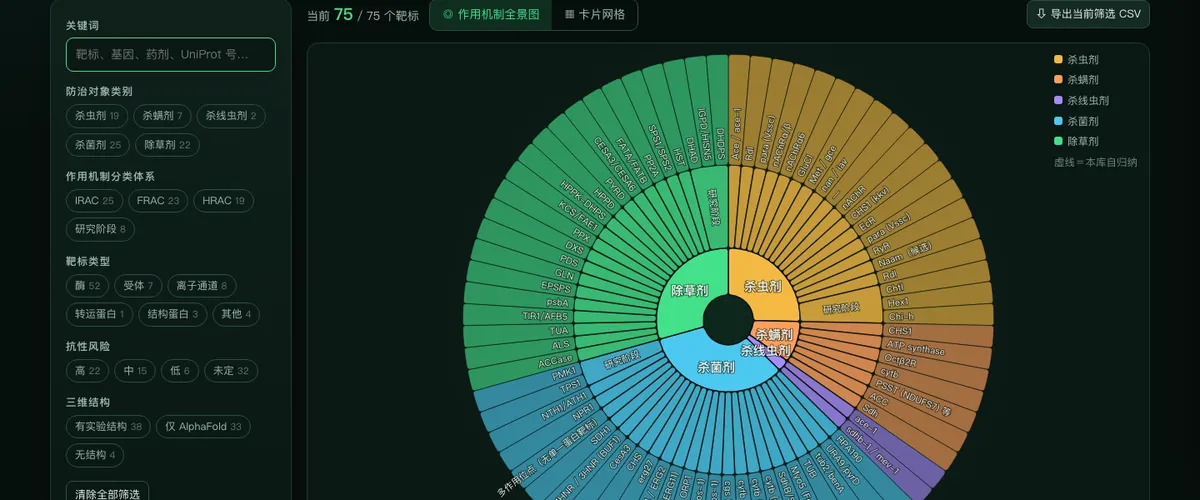 AgroTarget 禾靶In beta
agrochem.kway.cc · Home page public; demo on request
AgroTarget 禾靶In beta
agrochem.kway.cc · Home page public; demo on request
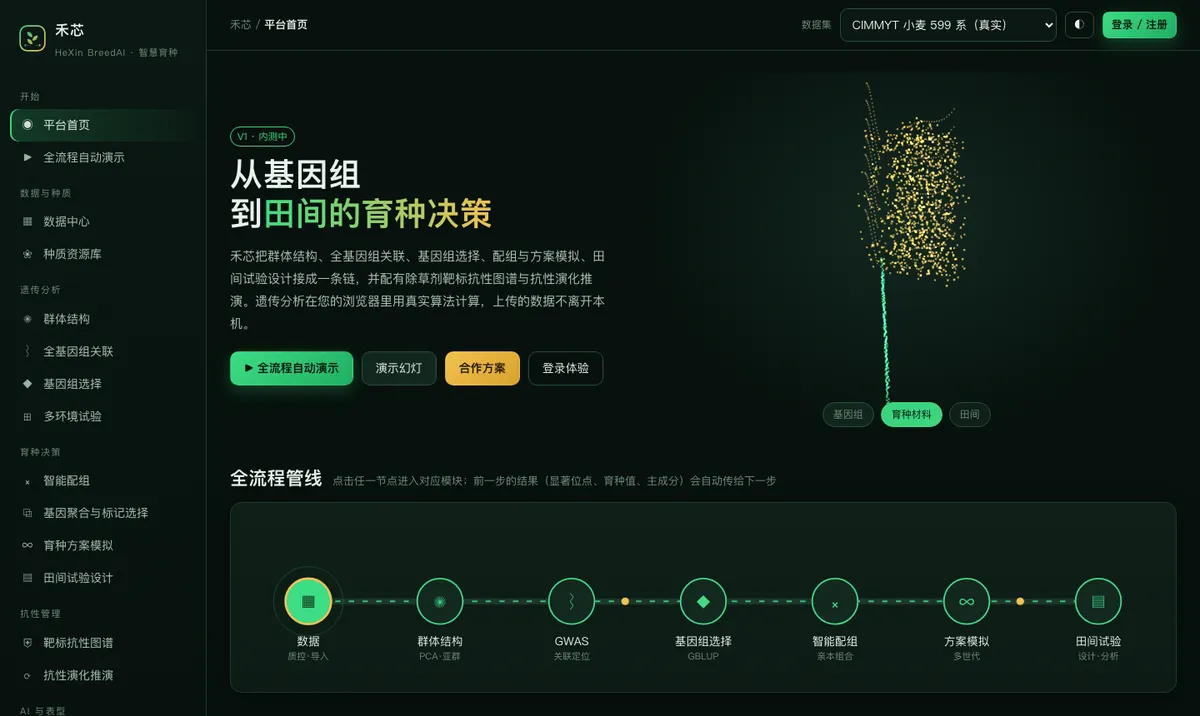 HeXin BreedAI 禾芯In beta
breeding.kway.cc · Open without sign-in
HeXin BreedAI 禾芯In beta
breeding.kway.cc · Open without sign-in
Screenshots taken on the live sites (2026-09-30); access checked anonymously on 2026-10-04.
What we do as projects
Five service lines. Every project starts with a written judgement of whether it is worth doing.
Molecular design and virtual screening
From a target or an activity requirement to a short list of molecules worth synthesising, with the reasoning for each candidate.
Research and public-sector data platforms
Login, permissions, approval flows, audit trails and dashboards for data that is currently scattered.
Research websites
Institution, lab and conference websites with a content back-end that non-technical staff can edit.
Scientific computing
Environment setup, job orchestration, checkpoint restarts and result verification for heavy computations.
Consulting and training
Whether an idea can be done with AI, how, and with what data; and teaching the method to your students.
Peer-reviewed record: 14 papers
Co-authored by our core team, each with a checkable DOI. Papers before August 2026 are the core team's prior work, not the company's.
Kway AI is the English short name used in author affiliations ("Kway AI, China"). The registered company name is 贵州启微智能科技有限公司 (Guizhou, China), founded in August 2026; the Chinese name is authoritative.
- A Unified Hierarchical Multiscale Fusion Framework for Drug–Target Affinity Prediction: From Benchmark Performance to Nanomolar Inhibitor DiscoveryAdvanced Science, 2026doi:10.1002/advs.77345
- AI for science: Progress, challenges, and perspectivesThe Innovation, 2026doi:10.1016/j.xinn.2026.101530
All 14 papers with DOIs
- Reshaping the drug discovery ecosystem with open science and collaborative innovationThe Innovation Drug Discovery, 2026doi:10.59717/j.xinn-drugdisc.2026.100016
- Spectral Decomposition of Chemical Semantics for Activity Cliffs-Aware Molecular Property PredictionAdvanced Science, 2026doi:10.1002/advs.202517579
- A hierarchical interaction message net for accurate molecular property predictionCommunications Chemistry, 2026doi:10.1038/s42004-026-01922-x
- Enhancing kinase-inhibitor activity and selectivity prediction through contrastive learningNature Communications, 2025doi:10.1038/s41467-025-65869-8
- A virtual platform for automated hybrid organic-enzymatic synthesis planningNature Communications, 2025doi:10.1038/s41467-025-65898-3
- Interpretable PROTAC Degradation Prediction With Structure-Informed Deep Ternary Attention FrameworkAdvanced Science, 2025doi:10.1002/advs.202508138
- Multi-modal deep learning enables efficient and accurate annotation of enzymatic active sitesNature Communications, 2024doi:10.1038/s41467-024-51511-6
- Generic Interpretable Reaction Condition Predictions with Open Reaction Condition Datasets and Unsupervised Learning of Reaction CenterResearch, 2023doi:10.34133/research.0231
- An adaptive graph learning method for automated molecular interactions and properties predictionsNature Machine Intelligence, 2022doi:10.1038/s42256-022-00501-8
- TrimNet: learning molecular representation from triplet messages for biomedicineBriefings in Bioinformatics, 2021doi:10.1093/bib/bbaa266
- RetroPrime: A Diverse, plausible and Transformer-based method for Single-Step retrosynthesis predictionsChemical Engineering Journal, 2021doi:10.1016/j.cej.2021.129845
- Introducing block design in graph neural networks for molecular properties predictionChemical Engineering Journal, 2021doi:10.1016/j.cej.2021.128817
Contact
Academic collaboration and commercial purchase: email yvquan.li@gmail.com, WeChat yvquanli. Write in English or Chinese: what you want to do, what input you have, and when you need it. First judgement within two working days.